






The AI infrastructure paradox: why cheaper tokens are doubling your cloud bill
- AI
Per-token pricing dropped nearly 80% over the last twelve months. Yet, in the enterprise space, nearly 60% of production AI deployments overshot their budgets by 30% to 50%.
This is the economic paradox defining modern AI engineering. The core issue isn't API pricing, but the broad industry shift: we transitioned from simple conversational chatbots to autonomous agent architectures without implementing any token governance.
The pain in production: When an application evolves from a basic Q&A system to an autonomous agent, token consumption stops scaling linearly and starts compounding. A single user-initiated task triggers a chain of background operations: planning steps, tool selection, observation validation, self-correction loops, and final synthesis.
What used to be a single API request silently becomes 12 billable round-trips.
At Active, when we audit client systems suffering from exorbitant LLM bills, we rarely find malicious traffic. What we find is pure structural waste:
The single-model trap: Routing simple tasks (like classification or entity extraction) to heavy models like Claude Opus or GPT-4o, simply out of developer convenience.
Context bloat in RAG pipelines: Injecting tens of thousands of raw vector tokens into the prompt context when, in reality, the model only needs two relevant paragraphs.
Uncached payload redundancy: Resending 4,000-token system prompts and complex tool schemas on every agent iteration without any prefix alignment.
Treating LLM cost optimization as a sporadic task (asking engineers to periodically edit the system prompt) yields illusory 5% reductions that vanish in two weeks. Achieving sustained 60% to 80% savings requires treating token governance as a fundamental architectural discipline.
The blueprint: Token governance across 5 layers
Here is the framework we use to embed token governance directly into the application layer:
1. Tiered inference routing Stop using frontier models as default executors. Implement a lightweight router at the API gateway to direct incoming subtasks based on the required reasoning depth. 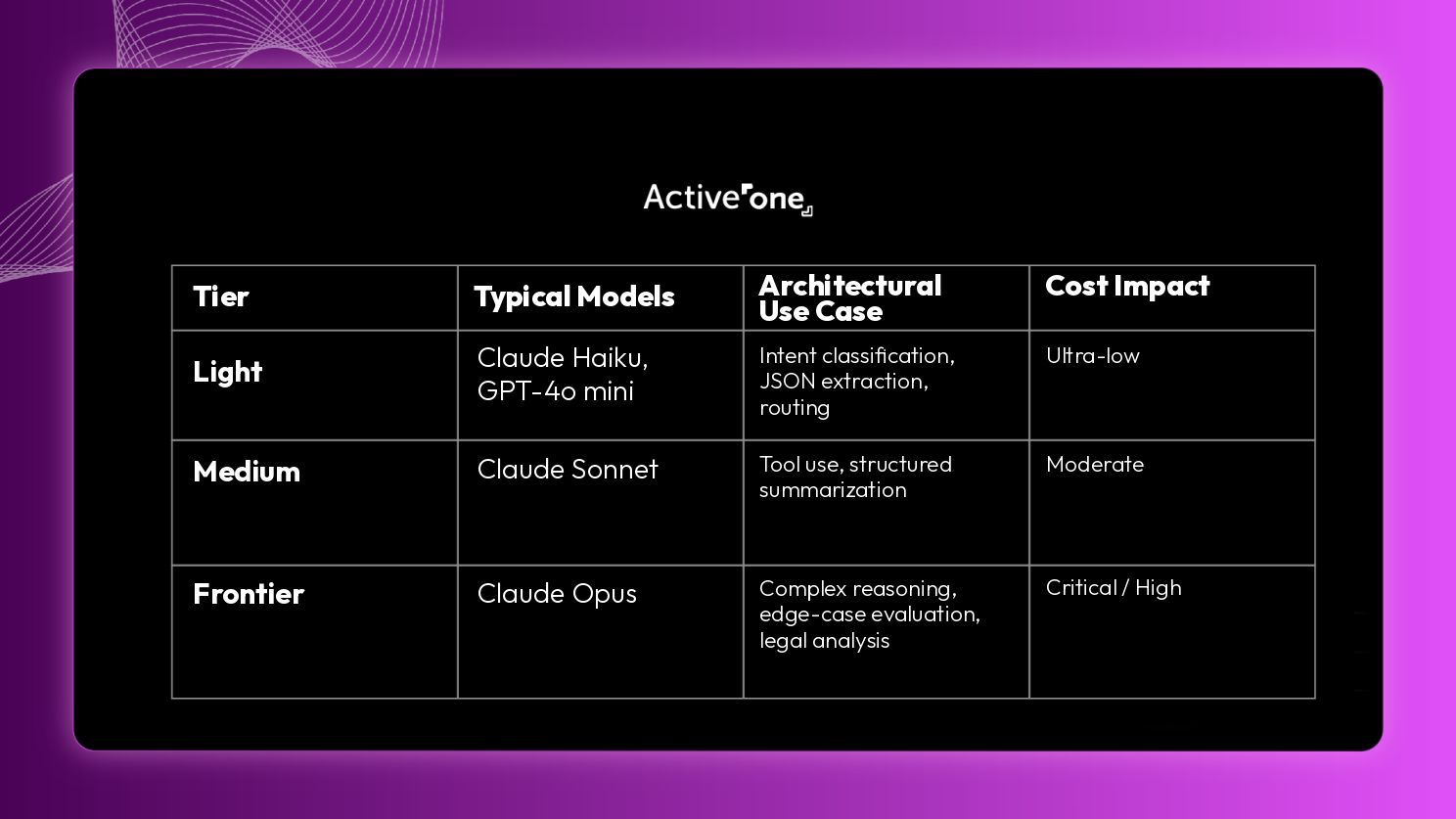
Dynamic fallback pattern: Execute on the lightweight tier first. Escalate to intermediate or frontier tiers only if output validators return low confidence or detect formatting failures.
2. Prefix alignment for prompt caching (Provider Level) Native provider caching (like Anthropic or OpenAI) offers up to 90% discounts on input tokens. However, these caches break if you place dynamic variables at the beginning of the payload. We enforce strict code discipline: all static context (system instructions, profiles, tools) goes at the absolute top of the prompt, isolating dynamic user input strictly at the bottom.
3. Semantic caching (Application Level) For applications handling recurring domain queries, calling an LLM every time is architectural malpractice. By deploying a vector-based semantic cache (tuning cosine similarity to ~0.92+), frequent queries bypass the LLM entirely. The result: <10ms response times and zero compute cost.
4. Per-task budgets and graceful degradation Never execute a reasoning loop (like ReAct) without a hard token limit. Inject a budget counter that decrements with each call within the loop's context. If the agent nears its limit, it must execute a gracefully degraded fallback (summarizing progress so far and returning partial results) instead of crashing with a timeout or draining the credit card in an infinite loop.
5. Strict output constraints Generated tokens (output) cost up to 5x more than ingested ones (input). RLHF-trained models are conversational by default; they repeat the prompt and pad with apologies. Eliminate billable verbosity by forcing strict JSON schemas, explicit limits ("Answer in 2 bullets"), and clamping the max_tokens parameter.
The trade-offs
In distributed systems, there are no silver bullets. Optimization comes at a price:
Smart routing injects an initial 10-30ms latency penalty before actual inference begins.
Semantic caching requires borderline paranoid tuning; a threshold set too low will serve outdated or decontextualized responses to users.
Aggressive prompt compression saves tokens, but sometimes destroys the subtle instructions needed for the model to handle edge cases.
AI optimization is a constant war between unit economics, speed, and accuracy. You can only pick two at any given node.
The elephant in the room: Where in the stack are you taking the hit?
The reality is nobody has this 100% solved on the first deployment. We broke semantic caching a couple of times in production by serving stale context before managing to calibrate the vector similarity thresholds.
For your team: At which layer are you implementing governance? Are you eating the latency penalty required by a smart router, or do you prefer to keep paying the "frontier model tax" for now to prioritize time-to-market?
Open to debating what other patterns we might be missing.
How does the Project Manager profession change in the AI era?